
Clash by Night **** (1952, Barbara Stanwyck, Robert Ryan, Paul Douglas, Marilyn Monroe, Keith Andes, J Carrol Naish) – Classic Movie Review 2,597
Fritz Lang’s heated classic 1952 film noir melodrama Clash by Night, based on the Clifford Odets play, is rivetingly played by a great vintage cast: Barbara Stanwyck, Robert Ryan, Paul Douglas, Marilyn Monroe.
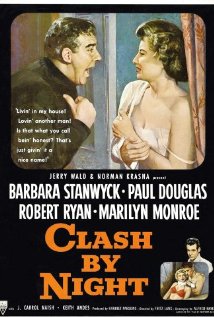
Director Fritz Lang’s heated 1952 film noir melodrama Clash by Night, based on the 1941 Clifford Odets play as adapted by screenwriter Alfred Hayes, is rivetingly played by a great vintage cast.
Barbara Stanwyck stars as cynical Mae Doyle, who returns to her small fishing village hometown of Monterey, California, and is courted by and then marries shy, good-natured, unsophisticated fisherman Jerry (Paul Douglas) and has a baby girl.
She despises Jerry’s tough friend Earl (Robert Ryan), a bitter, dissatisfied film projectionist, who fancies her right away and elbows in. But Mae becomes bored and restless after a year. Earl, now divorced, makes a move on Mae. She resists at first, but then begins an affair with him.

Mae’s brother Joe (Keith Andes) fears that his love, fish cannery worker Peggy (Marilyn Monroe), may wind up like Mae. This sub-plot with Monroe and Andes is secondary to the proceedings, but it causes quite a stir because it is Monroe making an early splash, even if it is in a genre that was not truly her own.
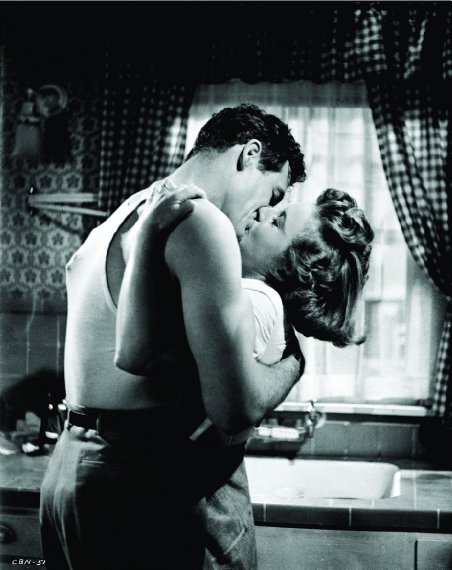
The film breaks into two almost equal parts, separated by a year, both beginning with a documentary look at the fishing industry in Monterey.
Stanwyck, in a role announced for Joan Crawford, has the film’s best line: ‘Home is where you come to when you’ve run out of places.’
The title comes from Matthew Arnold’s poem Dover Beach (1851). It is a place ‘where ignorant armies clash by night’.
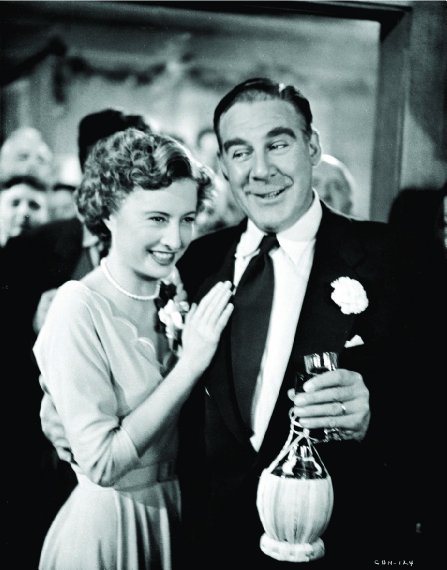
Also in the cast are J Carrol Naish, Silvio Minciotti, Diane Stewart, Deborah Stewart, Julius Tannen and Tony Dante.
It was the first film in which Monroe was credited before the movie’s title, fourth billing, but even so it is no more than a bit role.

During the shooting, the now famous nude calendar photos of Monroe surfaced. Reporters hounded her, creating problems for the film-makers. It was the point where the rising Monroe’s star was born and Stanwyck’s star was falling. How poignant that must have been for Stanwyck, who found her career inexplicably declining in the Fifties.

Clash by Night was originally performed in 1941 as a neo-realist Broadway play with Tallulah Bankhead. Sadly Bankhead wasn’t bankable at the movies. The film changes the Staten Island setting to a fishing town in California, but keeps the oppressive seacoast atmosphere.
The $1.5 million box-office take was very respectable.
The cast
The cast are Barbara Stanwyck as Mae Doyle D’Amato, Paul Douglas as Jerry D’Amato, Robert Ryan as Earl Pfeiffer, Marilyn Monroe as Peggy, Keith Andes as Joe Doyle, Silvio Minciotti as Papa D’Amato, J Carrol Naish as Uncle Vince, Diane Stewart and Deborah Stewart as Gloria D’Amato, Julius Tannen and Tony Dante.
Clash by Night is made by Wald/ Krasna Productions and distributed by RKO Radio Pictures.
Release date: June 16, 1952.
Clash by Night is directed by Fritz Lang, runs 105 minutes, is made by Wald-Krasna Productions, is released by RKO Radio Pictures, is written by Alfred Hayes, based on the play by Clifford Odets , is shot in black and white by Nicholas Musuraca, is produced by Jerry Wald, Norman Krasna and Harriet Parsons, and is cored by Roy Webb.
There is also a 1963 British film called Clash by Night, retitled Escape by Night in the US to avoid confusion, though more confusion arose as there are three other films called Escape by Night.
© Derek Winnert 2015 Classic Movie Review 2,597
Check out more reviews on http://derekwinnert.com
Barbara Stanwyck and Robert Ryan in Clash by Night (1952).

Recent articles
- Hammer the Toff *** (1952, John Bentley, Patricia Dainton, Valentine Dyall) – Classic Movie Review 13,86501 Mar 2026
- Scream 4 [SCRE4M] ** (2011, Neve Campbell, Courteney Cox, David Arquette, Hayden Panettiere, Anthony Anderson, Alison Brie, Adam Brody, Rory Culkin) – Classic Movie Review 13,86428 Feb 2026
- Best zombie movies27 Feb 2026
- King of the Zombies *** (1941, Dick Purcell, Joan Woodbury, Mantan Moreland, Henry Victor, John Archer) – Classic Movie Review 13,86326 Feb 2026
- The Lamp in Assassin Mews *** (1962, Francis Matthews, Lisa Daniely, Ian Fleming, Amy Dalby) – Classic Movie Review 13,86224 Feb 2026
Recent comments
- The President’s Lady ** (1953, Charlton Heston, Susan Hayward, John McIntire, Fay Bainter) – Classic Movie Review 13,846 | Derek Winnert on The Buccaneer *** (1958, Yul Brynner, Claire Bloom, Charles Boyer, Inger Stevens, Henry Hull, Charlton Heston) – Classic Movie Review 13,844
- Straight Up *** (2019, James Sweeney, Katie Findlay, Dana Drori, James Scully, Tracie Thoms, Betsy Brandt, Randall Park) – Classic Movie Review 13,839 | Derek Winnert on Twinless **** (2025, Dylan O'Brien, James Sweeney, Aisling Franciosi) – Classic Movie Review 13,838
- Phantom Killer ** (1942, Dick Purcell, Joan Woodbury, John Hamilton, Warren Hymer) – Classic Movie Review 13,837 | Derek Winnert on The Sphinx ** (1933, Lionel Atwill, Sheila Terry, Theodore Newton) – Classic Movie Review 13,836
- Detour ***** (1945, Tom Neal, Ann Savage, Claudia Drake, Edmund MacDonald) – Classic Movie Review 1,547 | Derek Winnert on The Last Crooked Mile *** (1946, Don Barry, Ann Savage, Adele Mara, Tom Powers, Sheldon Leonard, Nestor Paiva) – Classic Movie Review 13,834
- Big ***** (1989, Tom Hanks, John Heard, Jared Rushton, Robert Loggia, David Moscow, Mercedes Ruehl, Jon Lovitz, Josh Clark, Kimberlee M Davis, Elizabeth Perkins) – Classic Movie Review 287 | Derek Winnert on 18 Again! *** (1988, George Burns, Charlie Schlatter, Tony Roberts, Anita Morris, Red Buttons, Pauly Shore) – Classic Movie Review 13,815