
Criss Cross **** (1949, Burt Lancaster, Yvonne De Carlo, Dan Duryea) – Classic Movie Review 1,579
The tangled web 1949 film noir thriller Criss Cross stars Burt Lancaster, who returns to his LA home and finds his ex-wife (Yvonne De Carlo) ready to rekindle their old flame, but she has a new mobster boyfriend (Dan Duryea).
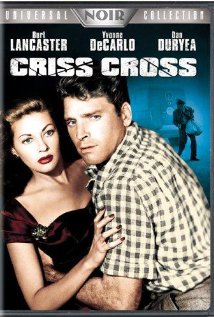
‘When you Double-Cross a Double-Crosser… IT’S A CRISS-CROSS!’
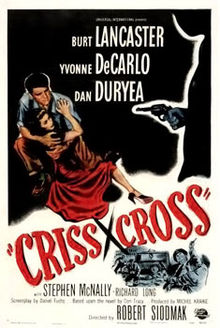
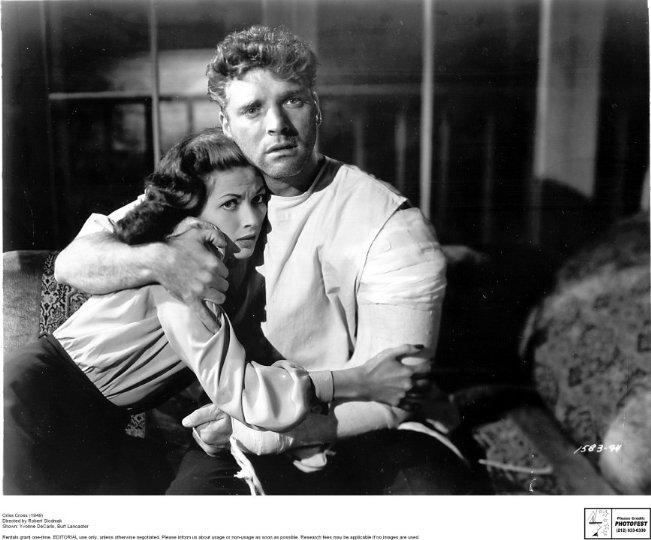
The 1949 American crime tragedy film noir Criss Cross stars Burt Lancaster, Yvonne De Carlo and Dan Duryea, and is directed by Robert Siodmak. Burt Lancaster and Yvonne De Carlo play an armoured truck driver and his ex-wife who conspire with a mobster (Dan Duryea)’s gang to have his own truck robbed.
Director Robert Siodmak’s intriguing tangled web of a 1949 thriller Criss Cross stars Burt Lancaster as Steve Thompson, who returns to his home town of Los Angeles and finds his lovely ex-wife Anna Dundee (Yvonne De Carlo) ready to rekindle their old flame. Reluctantly, but inevitably, Steve continues to see Anna, while deciding to resume his old job as a driver at an armoured-truck company.
The femme fatale encourages their affair even though she has a new boyfriend in mobster Slim Dundee (Dan Duryea), whom she then soon decides to marry. Despite this, Anna restarts a clandestine affair with Steve. But Steve gets into deep trouble and then gets himself embroiled in a robbery when the hoodlum starts to suspect the affair.
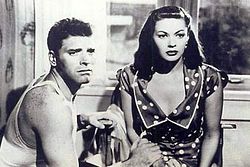
Anna and Steve are caught together by Dundee, but the quick-thinking Steve dangerously gets out of this spot of bother by leading Dundee and his gang into an armoured-truck robbery, conspiring with the gang to have his own truck robbed en route in a daylight caper.
Daniel Fuchs provides the fine screenplay for a classic tough and edgy film noir with a gripping climax, based on the 1934 novel by Don Tracy. There is plenty of hard-bitten dialogue, character building and time for quirky, digressional scenes, with semi-irrelevant characters and moments built it to add flavour. Slightly wordy it may be, but the movie is grippingly and moodily directed by Siodmak, handling the somewhat awkward initial flashback nature of the film carefully.
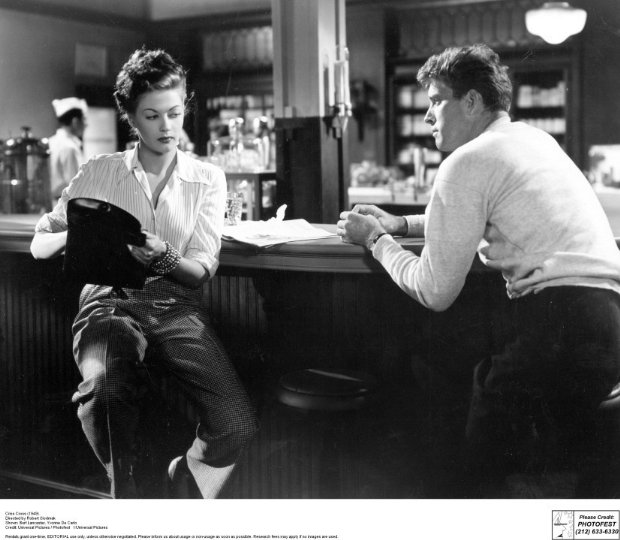
It is an excellent vehicle for the two mean and moody male stars, who inhabit and command the space to the manner born. The young-looking and romantically handsome Lancaster is the main star so the cameras are mostly on him and his allure, but Dan Duryea gets plenty of room to rage and glower as the huge-suited villain in a perfectly judged portrait of a frustrated, dissed man. His character is hardly any different from Lancaster’s, both men hopelessly in love with the same worthless, grabbing tramp that neither of them can have. Up to the challenge, De Carlo makes a strong, hard impression too, sharing sizzling screen chemistry with Lancaster. De Carlo’s character is a real piece of work, and the actress goes for it full on, the only way to go.
It is an ideal project for the three stars. As well as that, it is an ideal project for the director, who responds to the subject with an inspired noir vision, delivering a highly suspenseful, characterful and atmospheric movie.
In support, there are half a dozen outstanding character actor turns. They come from Percy Helton as the bartender Frank, Alan Napier as the boozy but canny crime planner Finchley, Griff Barnett as Lancaster’s old armoured truck buddy Pop, Joan Miller as the bar lush, Edna Holland as Lancaster’s old mother Mrs Thompson, and Isabel Randolph as the hospital nurse.
Franz Planer’s first-rate black and white noir cinematography, Bernard Herzbrun’s production designs and Miklos Rozsa’s stirring score are major assets. Using the city as one of the characters in the movie, it was shot partly on location in the noir favourite Bunker Hill section of Los Angeles, an area torn down in the 1950s and 1960s. The heist, when it finally comes, is excitingly, stylishly done, delivering the expected action goods with plenty of impact and a lot of Miklos Rozsa’s pounding score. But this is not what the film is about. It is a chamber piece. An indoors love triangle, doomed of course, utterly tragic.
It starts as it means to go on with a thrilling aerial panorama shot over the credits that ends at a nightclub just north of downtown Los Angeles. Steve Thompson lives with his mother at a house on the north-south thoroughfare Hill Street, above the north entrance of the Hill Street Tunnel. The tunnel, the hill and the house were razed in 1955. A highlight of the film are the lengthy scenes inside and outside LA’s Union Station.
The exterior and interiors of the rambling, rundown Sunshine Apartments on the steep Third Street steps are used for the planning of the heist, with the Angels Flight funicular seen through the hotel room windows.
There is just enough outside filming to make you beg for more, actually the whole film shot on location. Universal’s sets seem cramped, despite the imagination put in to design them and film them. The frustrating back projections haven’t worn well of course, in the same way that conversely the outside filming has worn brilliantly.
It runs a very taut and compact 88 minutes.
The producer Mark Hellinger died suddenly from a coronary thrombosis on , aged 44, nearly preventing the film going ahead. Later, Lancaster praised writer Fuchs for his success in reworking Hellinger’s idea of a racetrack heist into a fatal romantic triangle.
It is made and released by Universal-International, who reissued it in 1959.
Release dates: January 19, 1949 (Los Angeles) and February 4, 1949 (US).
Criss Cross showcases the film début of the 24-year-old Tony Curtis (uncredited) as a gigolo dancing with De Carlo in a key scene at the Round-Up Bar. Supposedly he landed the role after walking through the Universal lot, where he was spotted by Robert Siodmak, who asked him if he could dance and gave him an audition.
Once the dance called Jungle Fantasy (performed by Esy Morales) ends, Curtis disappears from the film. Curtis is the dance partner of DeCarlo in the sequence, with Lancaster looking lustfully, lovingly on. Like Lancaster, the cameras concentrate on DeCarlo so Curtis is hardly seen. Tiny though the role is, Curtis was picked from many young hopefuls auditioning for the director. Curtis was eventually to star with Lancaster in Trapeze in 1956 and Sweet Smell of Success in 1957.
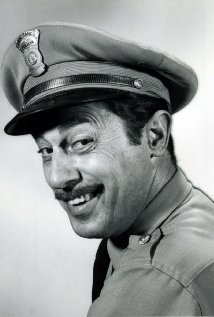
It is also the (uncredited) film debut of busy character actor Vito Scotti (1918–1996) as the track usher.
Criss Cross is the follow-up for Lancaster and Siodmak to their success in The Killers (1946). Criss Cross was remade as The Underneath by director Steven Soderbergh in 1995, with Peter Gallagher. Fuchs is credited as co-screenwriter with Soderbergh for The Underneath. He won an Oscar for Best Writing, Motion Picture Story, for the Doris Day-James Cagney Love Me or Leave Me (1955).
Mark Hellinger was one of the judges for a beauty contest sponsored by the Daily News in 1926. Ziegfeld showgirl Gladys Glad won. Hellinger was apparently glad all over. They married on July 11, 1929. She divorced him in 1932, and Hellinger was less glad, but a year later they remarried on the same date as their first wedding, and they remained wed until his death.
Bunker Hill was a large hill that separated the Victorian-era Downtown Los Angeles from the western end of the city. In the 1960s, the hill was lowered and the entire area was redeveloped to replace old frame and concrete buildings with modern high-rises etc for residences, commerce, entertainment and education.
The cast
The cast are Burt Lancaster as Steve Thompson, Yvonne De Carlo as Anna, Dan Duryea as Slim Dundee, Stephen McNally as Det Lt Pete Ramirez, Esy Morales as Orchestra Leader, Tom Pedi as Vincent, Percy Helton as Frank, Alan Napier as Finchley, Robert Osterloh as Mr Nelson, Griff Barnett as Pop, Meg Randall as Helen, Richard Long as Slade Thompson, Joan Miller as The Lush, Edna Holland as Mrs Thompson, John Doucette as Walt, Marc Krah as Mort, James O’Rear as Waxie, John ‘Skins’ Miller as Midget, Isabel Randolph as Nurse, Tony Curtis as dancer, Vito Scotti as track usher, Gene Evans, Timmy Hawkins, Geraldine Jordan, Garry Owen, Kenneth Patterson, Beatrice Roberts, Stephen Roberts, Charles Wagenheim, Robert Winkler.
Criss Cross is directed by Robert Siodmak, runs 88 minutes, is made and released by Universal International, is written by Daniel Fuchs, based on Don Tracy’s novel, is shot in black and white by Franz Planer, is produced by Michael Kraike, is scored by Miklos Rozsa, and is deigned by Bernard Herzbrun.
http://derekwinnert.com/the-killers-1946-burt-lancaster-ava-gardner-classic-film-review-1137/
http://derekwinnert.com/sweet-smell-of-success-classic-film-review-162/
© Derek Winnert 2014 Classic Movie Review 1,579
Check out more reviews on http://derekwinnert.com/

Recent articles
- Date with Disaster *** (1957, Tom Drake, William Hartnell, Shirley Eaton, Maurice Kaufmann, Michael Golden, Richard Shaw) – Classic Movie Review 14,01929 Aug 2026
- Travis Mc Gee *** (1983, Sam Elliott, Richard Farnsworth, Gene Evans, Barry Corbin, Geoffrey Lewis, Amy Madigan, Vera Miles, Katharine Ross, Marshall R Teague) – Classic Movie Review 14,01825 Aug 2026
- Tethered Wings [Les ailes collées] *** (2025, Roby Schinasi, Jérémy Kapone, Émilie Caen, Max Libert, Alexis Rosenstiehl) – Classic Movie Review 14,01723 Aug 2026
- Child in the House ** (1956, Eric Portman, Phyllis Calvert, Stanley Baker, Mandy Miller) – Classic Movie Review 14,01622 Aug 2026
- Death of a Corrupt Man [Mort d’un pourri] **** (1977, Alain Delon, Ornella Muti, Stéphane Audran, Klaus Kinski, Mireille Darc, Maurice Ronet) – Classic Movie Review 14,01522 Aug 2026
Recent comments
- The President’s Lady ** (1953, Charlton Heston, Susan Hayward, John McIntire, Fay Bainter) – Classic Movie Review 13,846 | Derek Winnert on The Buccaneer *** (1958, Yul Brynner, Claire Bloom, Charles Boyer, Inger Stevens, Henry Hull, Charlton Heston) – Classic Movie Review 13,844
- Straight Up *** (2019, James Sweeney, Katie Findlay, Dana Drori, James Scully, Tracie Thoms, Betsy Brandt, Randall Park) – Classic Movie Review 13,839 | Derek Winnert on Twinless **** (2025, Dylan O'Brien, James Sweeney, Aisling Franciosi) – Classic Movie Review 13,838
- Phantom Killer ** (1942, Dick Purcell, Joan Woodbury, John Hamilton, Warren Hymer) – Classic Movie Review 13,837 | Derek Winnert on The Sphinx ** (1933, Lionel Atwill, Sheila Terry, Theodore Newton) – Classic Movie Review 13,836
- Detour ***** (1945, Tom Neal, Ann Savage, Claudia Drake, Edmund MacDonald) – Classic Movie Review 1,547 | Derek Winnert on The Last Crooked Mile *** (1946, Don Barry, Ann Savage, Adele Mara, Tom Powers, Sheldon Leonard, Nestor Paiva) – Classic Movie Review 13,834
- Big ***** (1989, Tom Hanks, John Heard, Jared Rushton, Robert Loggia, David Moscow, Mercedes Ruehl, Jon Lovitz, Josh Clark, Kimberlee M Davis, Elizabeth Perkins) – Classic Movie Review 287 | Derek Winnert on 18 Again! *** (1988, George Burns, Charlie Schlatter, Tony Roberts, Anita Morris, Red Buttons, Pauly Shore) – Classic Movie Review 13,815