
The Deadly Affair ***** (1966, James Mason, Maximilian Schell, Simone Signoret, Harry Andrews, Harriet Andersson) – Classic Movie Review 2,113
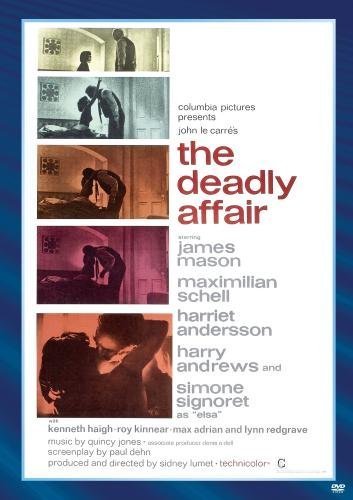
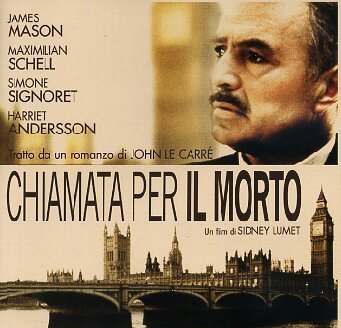
Sidney Lumet’s 1966 spy thriller film The Deadly Affair, adapted from John le Carré’s Call for the Dead, is chilling and riveting. James Mason plays le Carré’s famous British secret agent George Smiley, here called Charles Dobbs.
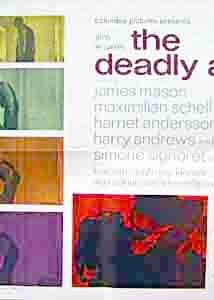
Producer-director Sidney Lumet’s important, serious-minded 1966 spy thriller film The Deadly Affair, adapted from John le Carré’s Call for the Dead is, as it should be, chilling, dour and downbeat, but rivetingly compelling. James Mason enjoys a huge star role as le Carré’s famous British secret agent George Smiley, here called Charles Dobbs, relishing every moment.
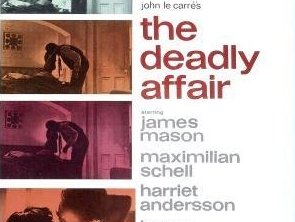
Director Lumet brings his American beady eye to the seedy English locations and makes the most of his special cast. While attending to the moody, doomy atmosphere, he ensures that are more than enough spy thrills, twists and turns, and suspense scenes too, as security officer Dobbs investigates the suspicious circumstances behind the apparent suicide of a high-ranking colleague Samuel Fennan (Robert Flemyng) from the Foreign Office, a man he has just shared a friendly chat with.
An anonymous typed letter had accused Fennan of being a Communist while at Oxford University and Dobbs has been asked to talk to him about it, which he does in a friendly way in London’s St James Park, happily clearing him of any alleged implied misdoings. But somebody else is in the park watching them. The next morning Fennan is found dead by his wife, supposedly having committed suicide.
Senior officials, like Dobbs’s controller Advisor (Max Adrian), want the circumstances surrounding the death swept under the carpet and are happy that it is officially called a suicide. But colleague Bill Appleby (Kenneth Haigh) wants Dobbs to investigate, with the help of retired policeman Inspector Mendel (Harry Andrews).
This sets Dobbs off on a tour of eccentric characters – his errant wife Ann Dobbs (Harriet Andersson), Fennan’s Jewish, Nazi-survivor wife Elsa (Simone Signoret), the dodgy garage owner Adam Scarr (Roy Kinnear), old friend and wartime colleague Dieter Frey (Maximilian Schell), Lynn Redgrave and Corin Redgrave as theatre folk Virgin and Larry – who, bit by bit, reveal that Fennan was assassinated and behind it all there is a web of spies. The seemingly mild-mannered Dobbs resigns in protest when his superior Advisor (Max Adrian) tries to take him off the case, and then finds himself under threat from an espionage ring.
Dobbs’s mild manner hides a multitude of rage, anger and pent-up violence. Mason suggests all this incredibly well, in a convincing, exciting tour-de-force. Harry Andrews is tremendous as the copper, up for a bit of gratuitous violence himself: his attack on garage owner (Roy Kinnear) is a shocking highlight of the film. Kinnear is excellent, no comedy here. Max Adrian camps around alarmingly, but Kenneth Haigh keeps campy light. Both are amusing. Lynn Redgrave and Corin Redgrave, parodying theatre folk, go for a bit of comic relief, which a mixed blessing, though it it sweet to see them young and fun like this. Simone Signoret turns on the tragedy effectively, quite grandly. Harriet Andersson has a tricky time trying to make the nasty Ann Dobbs character acceptable. She could never make her likeable, let alone loveable, though Dobbs continues to love her.
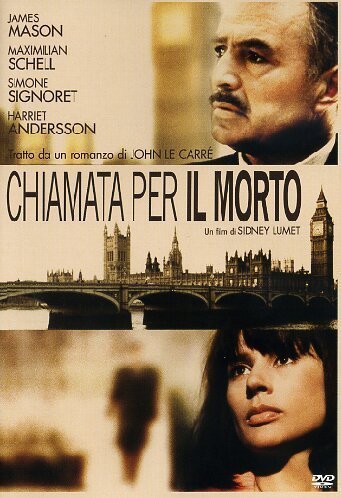
The Deadly Affair is securely based on an engrossing screenplay, largely faithful to le Carré’s novel, by Paul Dehn, the screenwriter of the previous year’s The Spy Who Came in from the Cold. Literate dialogue, memorable characters and clever, complex plotting vie for attention with the expert acting and Freddie Young’s bleakly evocative location Technicolor cinematography in muted colour. It could just have been in black and white, like its predecessor!
Location shooting took place around London. There is a lot of it, and it is very flavourful, now a time capsule of a partly vanished city. The Balloon Tavern, Chelsea, and the Serpentine Restaurant in Hyde Park (demolished in 1990) are no more. The exterior of Dobbs’s house is in St George’s Square, Pimlico.
A performance of Peter Hall’s Royal Shakespeare Company stage play of Edward II was re-created at its real location of the Aldwych Theatre, London, with David Warner as Edward II. Lumet makes extended use of this in a long Hitchcock-style suspense sequence.
Edward II doesn’t survive this very dark play, and a whole bunch of characters don’t survive this very dark film. Is it darker than its predecessor The Spy Who Came in from the Cold (1965)? It certainly competes with it on that front. In any case, it is a worthy successor, and Mason’s performance is a worthy successor to Richard Burton’s.
There were five BAFTA award nominations and astoundingly no wins.
The score is composed, arranged and conducted by Quincy Jones, which captures the Sixties zeitgeist, especially in the iconic title sequence, and the very Sixties bossa nova theme song ‘Who Needs Forever’ is performed by Astrud Gilberto, though this fits in less well and is over-used.
It is made by Sidney Lumet Film Productions.
Release dates: 26 January 1967 (New York City), 2 February 1967 (London premiere) and 7 April 1967 (UK).
It was cut for the US so there are two versions: 115 minutes (UK) and 107 minutes (US).
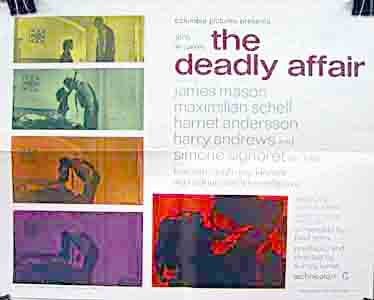
Simone Signoret (as Elsa Fennan), Harry Andrews (as Inspector Mendel), Harriet Andersson (as Charles’s errant wife Ann Dobbs), Kenneth Haigh (as Bill Appleby), Max Adrian as Advisor, Robert Flemyng as Samuel Fennan, Roy Kinnear as Adam Scarr, Lynn Redgrave as Virgin, Leslie Sands as Inspector, Corin Redgrave as Larry, Les White, June Murphy, Sheraton Blount as Eunice Scarr, Denis Shaw as Wilf the Barman, and David Warner (as the actor playing Edward II in the Aldwych Theatre) also grace the distinguished cast.
Call for the Dead is John le Carré’s first novel, published in 1961, and so introduces George Smiley, his most famous recurring character. However the film is a Columbia Pictures release and Paramount Pictures owned the film rights to the name George Smiley, so the central character is renamed Charles Dobbs. But the names of his police liaison Mendel (Harry Andrews) and wife Ann (Harriet Andersson) are the same. Paramount acquired the film rights to the Smiley character name for The Spy Who Came in from the Cold (1965), which introduced Smiley, played by Rupert Davies, though ironically he has very little to do.
George Smiley did become famous, partly thanks to the 1979 miniseries Tinker, Tailor, Soldier Spy, and 2011 film Tinker, Tailor, Soldier Spy, but not like James Bond.
The Deadly Affair is directed by Sidney Lumet, runs 115 minutes (UK) or 107 minutes (US), is made by Sidney Lumet Film Productions, is released by British Lion-Columbia (UK) and Columbia Pictures (US), is written by Paul Dehn, is shot by Freddie Young, is produced by Sidney Lumet, and is scored by Quincy Jones.
Quincy Delight Jones Jr (March 14, 1933 – November 3, 2024).
David John Moore Cornwell, aka John le Carré (19 October 1931 – 12 December 2020).
© Derek Winnert 2015 Classic Movie Review 2,113
Check out more reviews on http://derekwinnert.com/

Recent articles
- Abschied von Gestern – Anita G [Yesterday Girl] **** (1966, Alexandra Kluge, Günther Mack, and Hans Korte) – Classic Movie Review 13,89429 Mar 2026
- Artists Under the Big Top: Perplexed [Die Artisten in der Zirkuskuppel: ratlos] **** (1968, Hannelore Hoger, Sigi Graue, Alfred Edel, Bernd Höltz, Eva Oertel) – Classic Movie Review 13,89329 Mar 2026
- Tower of Terror ** (1941, Wilfrid Lawson, Movita, Michael Rennie) – Classic Movie Review 13,89228 Mar 2026
- Battle of the Coral Sea * (1959, Cliff Robertson, Gia Scala, Patricia Cutts) – Classic Movie Review 13,89128 Mar 2026
- That Was Then, This Is Now *** (1985, Emilio Estevez, Craig Sheffer, Kim Delaney) – Classic Movie Review 13,890 27 Mar 2026
Recent comments
- The President’s Lady ** (1953, Charlton Heston, Susan Hayward, John McIntire, Fay Bainter) – Classic Movie Review 13,846 | Derek Winnert on The Buccaneer *** (1958, Yul Brynner, Claire Bloom, Charles Boyer, Inger Stevens, Henry Hull, Charlton Heston) – Classic Movie Review 13,844
- Straight Up *** (2019, James Sweeney, Katie Findlay, Dana Drori, James Scully, Tracie Thoms, Betsy Brandt, Randall Park) – Classic Movie Review 13,839 | Derek Winnert on Twinless **** (2025, Dylan O'Brien, James Sweeney, Aisling Franciosi) – Classic Movie Review 13,838
- Phantom Killer ** (1942, Dick Purcell, Joan Woodbury, John Hamilton, Warren Hymer) – Classic Movie Review 13,837 | Derek Winnert on The Sphinx ** (1933, Lionel Atwill, Sheila Terry, Theodore Newton) – Classic Movie Review 13,836
- Detour ***** (1945, Tom Neal, Ann Savage, Claudia Drake, Edmund MacDonald) – Classic Movie Review 1,547 | Derek Winnert on The Last Crooked Mile *** (1946, Don Barry, Ann Savage, Adele Mara, Tom Powers, Sheldon Leonard, Nestor Paiva) – Classic Movie Review 13,834
- Big ***** (1989, Tom Hanks, John Heard, Jared Rushton, Robert Loggia, David Moscow, Mercedes Ruehl, Jon Lovitz, Josh Clark, Kimberlee M Davis, Elizabeth Perkins) – Classic Movie Review 287 | Derek Winnert on 18 Again! *** (1988, George Burns, Charlie Schlatter, Tony Roberts, Anita Morris, Red Buttons, Pauly Shore) – Classic Movie Review 13,815