
White Zombie **** (1932, Bela Lugosi, Madge Bellamy, Joseph Cawthorn) – Classic Movie Review 4,422
White Zombie (1932) starring Béla Lugosi as the evil voodoo master Murder Legendre is the very first zombie movie, introducing the classic image of a person turned into a mind‑less, enslaved zombie by a voodoo potion.
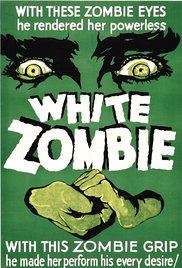
Director Victor Halperin’s haunting 1932 74-minute black and white horror movie White Zombie is all too cheaply made and mostly poorly acted. But it is a vintage classic none the less thanks to its exotic sets, eerie atmosphere, strange music and weird images, plus Bela Lugosi at his best, with a little help from Madge Bellamy as the heroine.
It is notable as the very first feature-length zombie film, the archetype and model for all the zombie movies that followed, introducing the classic image of a person turned into a mind‑less, enslaved zombie by using a voodoo potion. Though there are reanimated corpses or undead creatures in earlier horror movies, White Zombie is the first feature to use the term zombie and the one that provides the template that later zombie films could develop.
Lugosi stars as Murder Legendre, evil voodoo master and satanic king of the zombies down Haiti way. He supplies workers for the local sugar mills and lures away a beautiful young woman called Madeleine Short (Madge Bellamy), who has newly arrived there to wed her fiancé, bank employee Neil Parker (John Harron), and transforms her into a zombie.
Robert Frazer plays Charles Beaumont, as a fellow travelling plantation owner who is also in love with Madeleine, and, when they arrive in Haiti, asks for Legendre’s help to get her. [Spolier alert] But later Beaumont and Legendre fight to the death over her body.
Also in the cast are Joseph Cawthorn as missionary Dr Bruner, Brandon Hurst as Beaumont’s butler Silver, Frederick Peters as former executioner Chauvin, George Burr Macannan as zombie Von Gelder, and Clarence Muse as Madeleine and Neil’s coach driver.
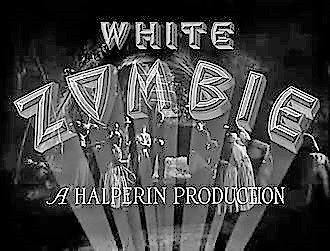
White Zombie is written by Garnett Weston, based on the 1929 novel The Magic Island by William Seabrook, shot in black and white by Arthur Martinelli, produced by Edward and Victor Halperin and scored by Abe Meyer. The music is another important ingredient. Meyer had orchestras record new versions of classic compositions, including Mussorgsky’s Pictures at an Exhibition, Gaston Borch’s Incidental Symphonies and Hugo Riesenfeld’s Death of the Great Chief, as well as music by Richard Wagner, H Maurice Jacquet, Leo Kempenski and Franz Liszt.
Most strikingly, the film begins with Chant, a composition of wordless vocals and drumming, created by Universal Studios employee Guy Bevier Williams, a specialist in ethnic music.
Victor and Edward Halperin Productions and Amusement Securities Corporation produced the film and it was released by United Artists.
White Zombie was filmed in 11 days in March 1932. Much of it was shot on the Universal Studios lot, re-using props and scenery from their horror films, and the rest at Bronson Canyon. The small budget necessitated night-time filming. Set designer Ralph Berger used the sets of the great halls from Dracula (1931), pillars and a hanging balcony from The Hunchback of Notre Dame (1923), the dark corridors from Frankenstein (1931) and chairs from The Cat and the Canary (1927). No wonder it looks great!
Defying poor reviews, especially for the acting, the independent feature made a substantial profit, though it was less successful than Universal’s classic horror movies.
Legendary Jack Pierce (Frankenstein, The Wolf Man and The Mummy) was Lugosi’s make-up artist.
The first screening on June 16 1932 in New York City was a 74-minute version, but distribution prints ran for only 69 – 70 minutes. Sadly, the 74‑minute version is considered lost. All existing copies (DVD, Blu‑ray, streaming, and archival restorations) are based on the shorter theatrical edit.
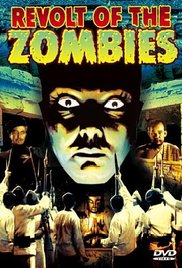
A follow-up, Revolt of the Zombies, also directed by Victor Halperin, was released in 1936, alas without Lugosi, but Dean Jagger instead. Victor and Edward Halperin Productions intended it as a sequel but their White Zombie financial partners Amusement Securities Corporation sued them and stopped them from promoting it as such.
Bellamy recalled that Lugosi was very pleasant and that he kissed her hand in the morning when they came on to the set. It is thought that Bellamy and Lugosi were both paid $5,000.
Former stage star Bellamy (1899–1990) (The Iron Horse [1924], Lorna Doone [1922]) did not take to sound and her film career petered out after White Zombie.
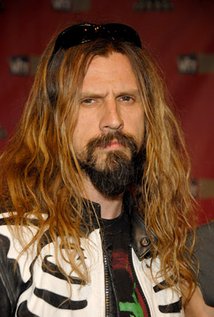
Rob Zombie co-founded the American heavy metal band White Zombie, named after this film. Geffen Records released their third studio album, ‘La Sexorcisto: Devil Music Volume One’ in 1992, selling more than two million copies in the US. White Zombie released their fourth and final album, ‘Astro-Creep: 2000 – Songs of Love, Destruction and Other Synthetic Delusions of the Electric Head’, in 1995 before disbanding in 1996.
Zombie says: ‘It’s a great film that not a lot of people know about. It amazes me that a film that is so readily available can be so lost.’
The cast
The cast are Béla Lugosi as Murder Legendre the voodoo master, Madge Bellamy as Madeleine Short, Dwight Frye as servant John, John Harron as Neil Parker, Robert Frazer as Charles Beaumont, William V Miller as Dr James, Eddie Pope as Hector, James M Cox as Miller, Ruth Hall as Mrs Beaumont, Joseph Cawthorn as missionary Dr Bruner, Brandon Hurst as Beaumont’s butler Silver, Frederick Peters as former executioner Chauvin, George Burr MacAnnan as zombie Von Gelder, and Clarence Muse as Madeleine and Neil’s coach driver.
White Zombie is directed by Victor Halperin, 74 minutes or 69 – 70 minutes, is made by Victor and Edward Halperin Productions and Amusement Securities Corporation, is released by United Artists, is written by Garnett Weston, based on the 1929 novel The Magic Island by William Seabrook, is shot in black and white by Arthur Martinelli, is produced by Edward Halperin and Victor Halperin, is scored by Abe Meyer, and is designed by Ralph Berger.
Best zombie movies
Best zombie movies: White Zombie (1932), Revolt of the Zombies (1936), King of the Zombies (1941), I Walked with a Zombie (1943), Revenge of the Zombies [The Corpse Vanished] (1943), George A Romero’s Night of the Living Dead and Dawn of the Dead. 28 Days Later, Shaun of the Dead, Train to Busan, World War Z (2013), Resident Evil (2002).
© Derek Winnert 2016 Classic Movie Review 4,422
Check out more reviews on http://derekwinnert.com

Recent articles
- Best zombie movies27 Feb 2026
- King of the Zombies *** (1941, Dick Purcell, Joan Woodbury, Mantan Moreland, Henry Victor, John Archer) – Classic Movie Review 13,86326 Feb 2026
- The Lamp in Assassin Mews *** (1962, Francis Matthews, Lisa Daniely, Ian Fleming, Amy Dalby) – Classic Movie Review 13,86224 Feb 2026
- Strange River [Estrany riu] **** (2025, Jan Monter, Nausicaa Bonnín, Jordi Oriol, Francesco Wenz, Bernat Solé, Roc Colell) – Classic Movie Review 13,86121 Feb 2026
- The Last First Time [El fin de las primeras veces] *** (2025, Alejandro Quintana, Jaime Bernache, Erick Guillen Torres) – Classic Movie Review 13,86021 Feb 2026
Recent comments
- The President’s Lady ** (1953, Charlton Heston, Susan Hayward, John McIntire, Fay Bainter) – Classic Movie Review 13,846 | Derek Winnert on The Buccaneer *** (1958, Yul Brynner, Claire Bloom, Charles Boyer, Inger Stevens, Henry Hull, Charlton Heston) – Classic Movie Review 13,844
- Straight Up *** (2019, James Sweeney, Katie Findlay, Dana Drori, James Scully, Tracie Thoms, Betsy Brandt, Randall Park) – Classic Movie Review 13,839 | Derek Winnert on Twinless **** (2025, Dylan O'Brien, James Sweeney, Aisling Franciosi) – Classic Movie Review 13,838
- Phantom Killer ** (1942, Dick Purcell, Joan Woodbury, John Hamilton, Warren Hymer) – Classic Movie Review 13,837 | Derek Winnert on The Sphinx ** (1933, Lionel Atwill, Sheila Terry, Theodore Newton) – Classic Movie Review 13,836
- Detour ***** (1945, Tom Neal, Ann Savage, Claudia Drake, Edmund MacDonald) – Classic Movie Review 1,547 | Derek Winnert on The Last Crooked Mile *** (1946, Don Barry, Ann Savage, Adele Mara, Tom Powers, Sheldon Leonard, Nestor Paiva) – Classic Movie Review 13,834
- Big ***** (1989, Tom Hanks, John Heard, Jared Rushton, Robert Loggia, David Moscow, Mercedes Ruehl, Jon Lovitz, Josh Clark, Kimberlee M Davis, Elizabeth Perkins) – Classic Movie Review 287 | Derek Winnert on 18 Again! *** (1988, George Burns, Charlie Schlatter, Tony Roberts, Anita Morris, Red Buttons, Pauly Shore) – Classic Movie Review 13,815